
Transition
FRIDAY
2 MAY 2025—
What we know of transitions — a shift, a change in our perspective or state of being — is that we are in the ever-present state of them.
Oh, if we could just let ourselves float. Lately, I’ve been floating a little — and also tussling with myself. Luckily, I am not floundering as much as I was just a few weeks ago. My days are evening out and flowing much easier now, which brings me to a place of gratitude and more profound peace. What a relief.
Frozen February made way for a welcome spring thaw. The soil masks undercurrents of movement and growth. Behind our eyes and resting flesh, electric synapses are firing, impatiently waiting for our first move.
It reminds me of the David Whyte poem, “Start Close In.” He recently had a Three Sundays series that centered on that idea. I love these lectures so much.
It’s important we clear space emotionally and physically. What do I need to clear out? PLENTY. I made a “top 5” priority list for myself out of a laundry list of voices calling.
What’s my first step? Edit one poem.
Next step? Hold my beer …
“On any given day,
seismic shifts can rattle our skulls,
tectonic plates crack open
earthen mounds of understanding
making wide a new way forward. ”


July 5
The word holiday has such a restful ring to it. Mine certainly was. I hope yours was, too.
There can be myriad ways to fill the span of a day, whether work or whim; though, what freedom in a today where we decide which path we follow, whatever way the wind of our minds blow.
No alarms will chime—only the questioning nudge from the sunlight peaking through the gauzy, white window curtains, asks of me, How shall we follow our hearts today? During a July of humid, hot daylight hours, a welcome front porch breeze woos me to gently wake into the presence of the morning. The resident Mourning dove gifts me a sultry sigh, a reminder that I have in my possession a pocketful of cash to spend, a currency of luxury, a day of whim. We lean into a rhythmic current and songbirds ask me to joyfully join in the choir’s chorus, a prelude of rejoicing before today’s sermon. From hand to hand, we pass the offering plate, placing in it the living, breathing desires our animal heart of hearts, inhaling and exhaling the dreams of hopeful human harmonics.
And, I have another poem for you:
4th of July
Last night I chased a sunset.
With small-minded impulsivity,
I thought I could catch it—
Wrong turn after crooked wrong turn,
as elusive as a housefly,
taunting me with an air of
orange sherbet glory glow,
it mockingly hid
shadowed behind the growing tree line
behind houses and highway signs
while the coverlet of darkness dove in the evening’s
deepest of waters
dampening intentions and excitement with
disappointment
no matter how hard my size 9 and a half lead foot
pressed pedal and accelerator.
Defeated, the truck gave in to whims and
turned towards home.
The eastern sky blackened velvet,
the westerly glow dwindled down
still burning a flushed flesh
with purple-whipped pillows of storm clouds standing against the horizon
less fervently than a mere two minutes before.
As if on cue—fireworks began to bloom over
the silhouette of treetops,
streaking the air,
lives so brief and fantastical:
a painterly illustration of our shared moment of
impermanence,
a lesson in existence
as mere footnotes of
a more expansive narrative—
too much for our minds to hold.
Longing to be seen,
longing to be heard,
longing for lasting legacy,
longing to awe the world with our
short-span heroics.

May's Tanka

Taken on the magical Blue Ridge Parkway en route to experience the blue ghost fireflies in the Pisgah Forest. And, no, I will not miss an opportunity for a good photo, even if I’m driving. Brevard, NC. May 2024.
The nestling robin says,
I may fly today.
The sun-drenched seedling says,
I may further inch my way.
What may you try this month of May?
I recorded this in my backyard at dusk with a chorus of chittering chimney sweeps, crickets, and cardinals.

April's Tanka
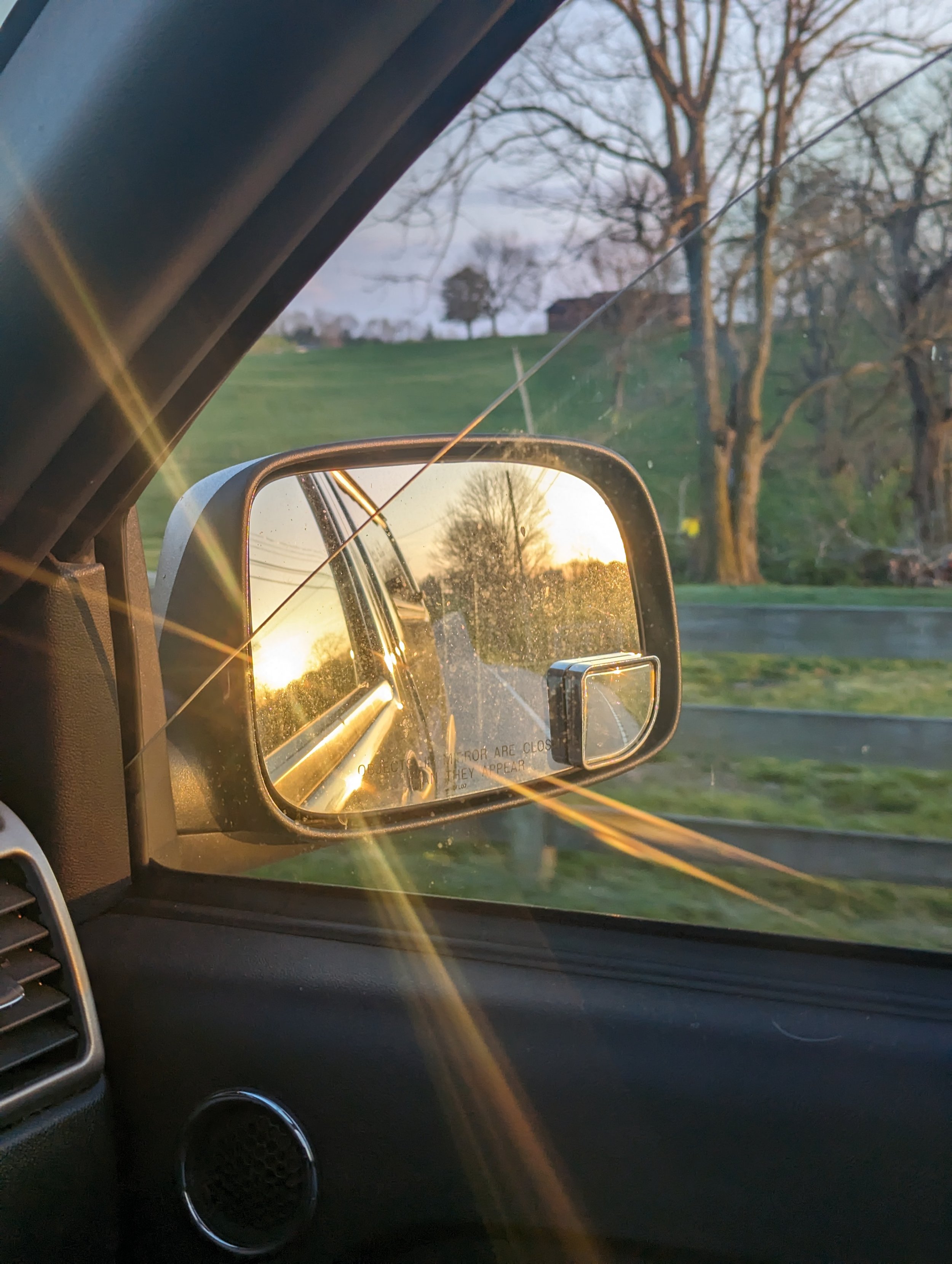
If your windows and rearview mirrors aren’t dirty, y’ain’t doing it right.
By the time April rolls around, I’m done with winter weather and I’m tired of it toying with my emotions.
Winter voices unfinished work with I take it back cold snaps and rainy day tantrums, while a chorus cries, “You’ve had long enough.”

A Tanka for National Poetry Day

Happiness is woven out of spider silk where dew collects like little love letters and comes tumbling towards your open mouth. —AJK
If you’d like to watch my tanka in a motion picture medium, visit me on IG.

March Tanka

Angus runs at one of his favorite places, the Montgomery Library Park. March 2024.
March pushed its way up through the bald earth with its longer days, renewed friendships and the scent of homecoming, as if to say, “ta da.”

February Tanka
February was a fast-moving train that rolled through every few hours, shook the house, and moved on—time for new horizons.

My bed for the night. Belle Plaine, Kansas.
A little backstory:
In February, I found myself all points west of the Mississippi—from Arkansas to Oklahoma to Kansas. The last place my feet landed was a lovely little blip on the map called Belle Plaine, Kansas. We arrived after dark and my generous hosts put me up in a guest house at the Bartlett Arboretum.
It was Valentine’s Day and I crashed their dinner, though I felt the warmth they shared with me.
They put me to bed with extra blankets piled on top of my body and my tired head faded into a delirious and happy sleep.
In the middle of the night, though, I woke up as my body rhythmically rocked back and forth: a train was traveling through. And, in my dream state haze, it could have been right outside the door for all I knew. The horn blew a time or two in the distance and the Burlington Northern rocked me gently back to sleep with a smile on my face.
How damned dreamy.
The next morning, after coffee and conversation with some new acquaintances, the Soil Sisters and one Soil Brother (a group of dedicated volunteers who help plan, prepare, and plant for the spring and summer seasons at the Arboretum), I took advantage of a small window of time to take a lap around the grounds.
Nothing was blooming yet on the property, but this place had a magic to it. I could feel it through the frost as I walked on the trails, past the outbuildings, and around the edge of the pond. My heart was pounding under the cold ground just as hard as I imagined the perennials were, impatiently waiting for spring.
I wrote a poem for my hosts based on our car ride into Belle Plain sunset. Side note: It has since gone to a poetry class and gotten a critique…so we’ll see how she changes from the first iteration below. Since you have the backstory, it may be easier to flow with the idea.
Little Moth
Tulsa grit
washed clean off
with each click of
the odometer,
with each whisper past
the mile markers,
the unraveling spool of
yellow yarn rolling out from underneath us
joining junctions of interstate and two-lane highways—
where soon enough
darkness rose in the air,
subtle as gasoline fumes.
We fluttered westward towards
a porchlight glow
that stretched its arms
wide with welcome across the horizon,
beckoning us home.
"I had a friend once tell me
Kansas is a little too much sky."
No, never! said this little moth.
I turned my eyes back
towards the blinding brilliance before me,
lifted off into the night
and got
joyfully lost.

Year of the Tanka
The Poetry Gauntlet, a year-long workshop for the working poet, began at the end of January. Once a month, we converge for class at the Carnegie Center for Learning and Literacy in Lexington, Kentucky.
One of the first poetry forms we learned was a “tanka.”
According to Poets.org:
The tanka is a thirty-one-syllable poem, traditionally written in a single unbroken line. A form of waka, Japanese song or verse, tanka translates as “short song,” and is better known in its five-line, 5/7/5/7/7 syllable count form.
History of the Tanka Form
One of the oldest Japanese forms, tanka originated in the seventh century, and quickly became the preferred verse form not only in the Japanese Imperial Court, where nobles competed in tanka contests, but for women and men engaged in courtship. The tanka’s economy and suitability for emotional expression made it ideal for intimate communication; lovers would often, after an evening spent together (often clandestinely), dash off a tanka to give to the other the next morning as a gift of gratitude.
I love that so much. Maybe it’s the songwriter in me but these tankas come flowing out (and sometimes out of nowhere) and it’s such a fun puzzle of words to decipher and create. I decided that I would write a tanka that encapsulated the essence of each month this year in 2024.
And, because I’ve been wanting to delve back into a passion for creating video content, I’ll eventually encapsulate them into motion pictures.
This one didn’t get a video but it has a photo to accompany the sentiment.
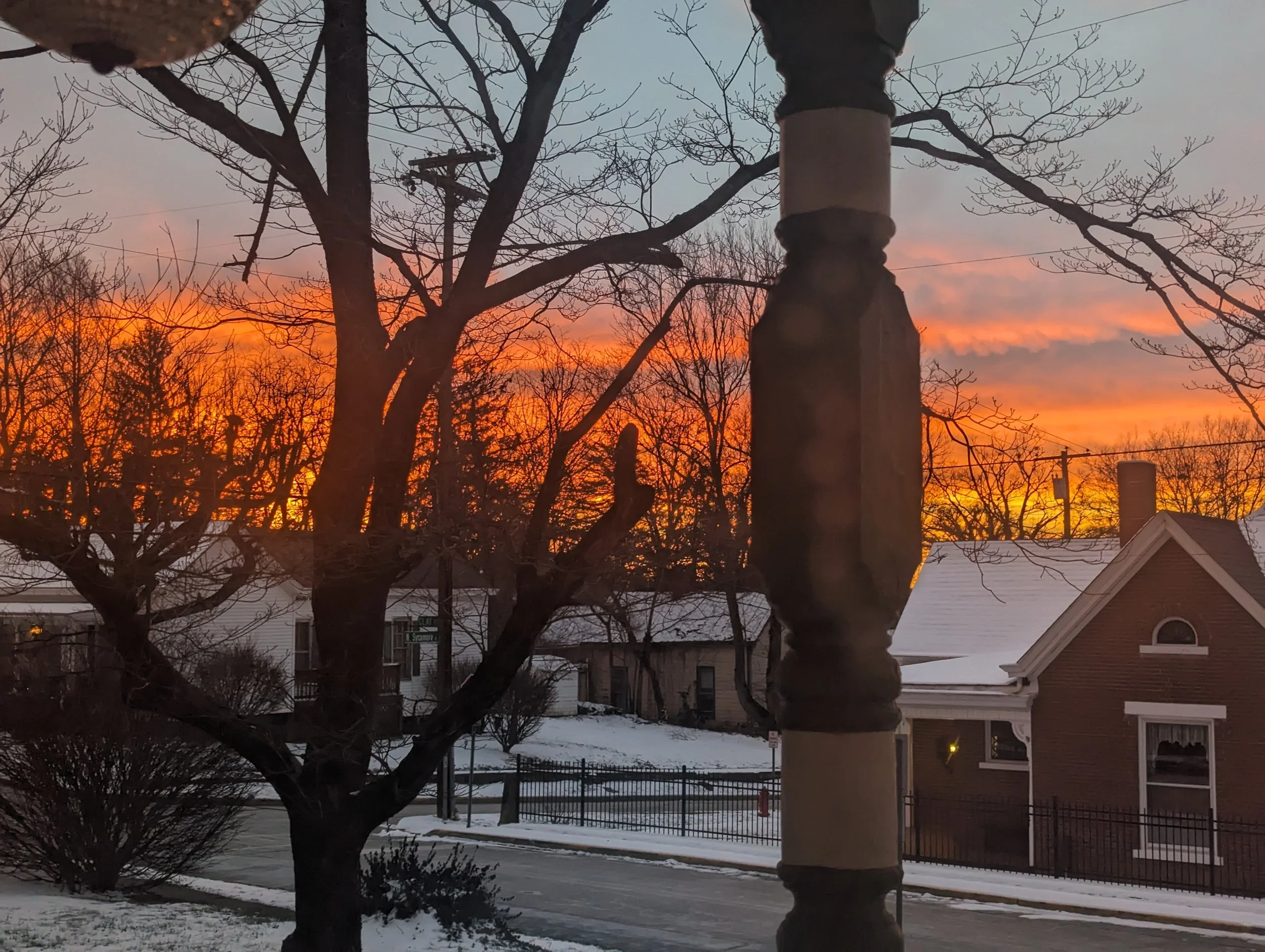
The front door view of a spectacular sunset. 18 Jan 2024.
January Tanka
As wide as the snowfall, January walked into the year as subtle and raw as she left it, planting in her footsteps seeds of intentions, promises, and even a little hope.

A Midwinter Poem
Since snow still covers the ground, the temperature won’t lift itself higher than 15° today, and most everyone I know is braving the winter weather, I’ll share my warmth with you in the form of a midwinter poem.
My frozen fingers are typing madly in an attempt to generate some heat on this -5° morning in Kentucky. I have yet to feel them but together it seems we can manage to plink out a few words.
I’m a little shy about sharing this, which, if you know me, you may think is out of character since my book is usually wide open to the world, for lack of a better euphemism.
This week marks the beginning of The Poetry Gauntlet and in the words of Lexington’s Carnegie Center description: “it is an intense one-year workshop for poets.” No doubt it will take some steady breathing and carefully placed steps to scale this one, but I can’t freakin’ wait. In that spirit, here she goes.
If you would like to listen to me read this poem aloud, press play.
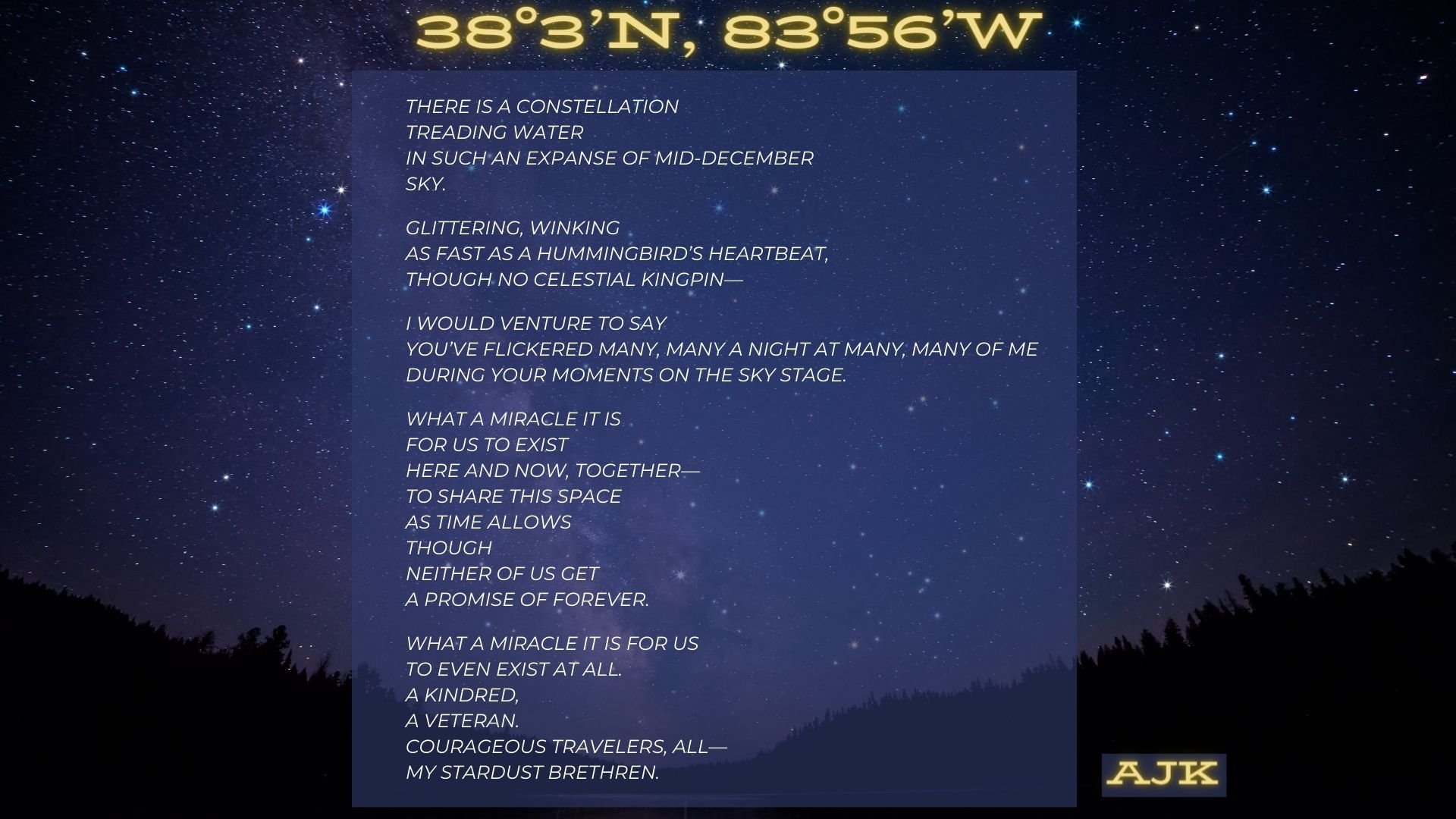

Your Permission Slip
A few months ago, I noticed a feeling of resistance in my body and a voice, the Old Grump, began to doggedly dictate a few incessant “shoulds” at me.
I didn’t like it.
On the wall by my desk is a shelf where I’ve shoved notecards, postcards, and Polaroids. I initially used some of the plain notecards to write down lyrics and ideas but now they also get cut up for various purposes in my art journal. There are a ton of pink ones still leftover, in part because it’s not my favorite color but now I’m glad they’re around.
Permission is such a subtle little-nothing kind of thing, especially for us adults who don’t technically need anyone’s permission to live our lives. Oh, if only that were true! We spend our lives being told what to do and not do, projected onto by other people’s fears or lack of understanding; and, end up perpetually asking permission from the other humans in our lives by unconsciously returning for endorsement and validation to just be ourselves.
For many people—especially those of us who had to wage battle for acceptance as creatives in our family unit and beyond—we get continually stuck in permission purgatory, continually arriving at a familiar crossroads. The old belief system bubbles up and still lingers, we psyche ourselves out and limit ourselves by repeatedly saying “no” or “can’t” or “don’t.” In our heads, we wrestle with the ultimate time-waster of them all, the Old Grump, and stew in a state of paralysis whereby nothing gets done.
We’re doubtful. We’re defeated. We’re done.
Boo!!
Whether my inner voice told me that I should be more productive with the time I’m given instead of taking a brain break or going for a walk or, or, or because it’s a frivolous luxury—the list goes on and on.
Eventually, it occurred to me that maybe there’s something to this whole permission thing.
Granted, permissions have been a part of my growth process or I wouldn’t have arrived at my present-tense coordinates, right? But to be honest, I don’t remember it being an intentional, active, part of my practice. Not exactly.
The pink notecards brought to mind “pink slips” from middle school. At least, that’s when I remember seeing one last. Permission to roam the halls during class to go to the bathroom or make your way somewhere else but it always made you feel exclusive and special and trusted.
So, I grabbed some pink notecards from the shelf, cut them into fours, and began writing messages to myself—and, by God, what a revelation! My spirit needed that. It shut the Old Grump down. What’s more, the rigidity in my body changed almost immediately.


Muscles and mind ease up on the vise grip just enough to wiggle out from underneath the weight of the mindset. We move ahead with the feelings that need processing in morning pages or the lines of a poem you're working through, the nap for which your body begs—it goes on, doesn't it?
Tangible reminders drive the point home so well—we need that! Whether it affixes itself to your journal page or is attached to a prominent location in front of your face, it is a tremendously important directional that gets us out of our heads long enough to propel us forward.
It can be as simple as “It’s ok.” It can be long-winded. What do you need today? What do you need to hear right now?
Tell yourself the caring words to release from the old patterns and old stories that hold you back so you can finally inch, step, lurch, leap ahead.
Give yourself that gift.

I choose adventure.
Earlier in the summer a friend and I met in Owensboro, Kentucky to spend the weekend at ROMP. We set up camp and got ready to explore the festival grounds for the evening.
After going back and forth about what we should do first, he mentioned another friend who once said, “Always choose adventure.” We made a pact then and there to do the very same.
It gave our spirits a lift just saying it out loud and the excitement of the awaited unknown was ready for us to meet it. Over the next two nights, we saw Tuba Skinny, Greensky Bluegrass, ate watermelon & mint salad, stood mesmerized by Ricky Skaggs and Kentucky Thunder, The Infamous Stringdusters, shared a pizza, caught Molly Tuttle and Golden Highway. One of my favorite parts of the weekend was crossing a bridge with lots of fairy lights that led us to a small, magical cabin stage for a late-night jam with The Slocan Ramblers.
Today, when you’re faced with the question, “What should I do next?” or “Where should I go now?”
Always choose connection.
Always choose vulnerability.
Always choose authenticity.
Always choose the adventure of participating as deeply as you can right there in the moment. It’s always fun to see who meets you there.
The video below came up as a suggestion for me to listen to, which I did the morning after I made this post. And, it occurred to me that it was a beautiful bookend that belonged here. It’s a short little thing, and well worth the listen.
If you’ve never listened to On Being, I encourage you to dive into the series. It lives wherever you listen to podcasts and there is also a lot to be found on YouTube as well. There are poems and snippets for sharing, longer conversations for quiet drives, and plenty more to discover. I have also enjoyed Krista’s off-season summer newsletter, The Pause, and Poetry Unbound.
Enjoy.

Summerstorm
This is the storm I’ve been waiting for all summer.
I woke up from an afternoon nap and lay there for a few minutes. In the back bedroom where I slept, it was dark and quiet—more difficult to hear the soothing patter like you can in the older part of the house. It’s a difference in insulation from the world and in the original build, there’s not as much between you and me and the rest of the world.
The rain fell hard and all at once, sounding more like white noise than a summer storm.
As I lay there, my mind ruminated over and over again about things I said to a friend.
I lifted myself up from the bed and opened the back door to a deluge of summer rain and I think I smiled. At least, my heart did.
The storm passed by a little too quickly for my taste. It couldn’t—and didn’t—sustain all that force for any swath of time.
By the time I made it to the front porch, the downpour had lost most of its life force. A steady stream of roof run-off flowed down the middle of the driveway and down into the street. The back half of my body made contact with the seat cushion and as I rested back in the chair, my ears noted the raindrops have a widely different timbre, depending on the surface they hit—a slap on the expansive elephant ear waving from pounding force of nature at the edge of the porch, a thud from landing in the arms of a long-established puddle from the gutter drain, or a tap-tapping off the roof’s edge.
The excited chatter from the trees told me that sparrows and cardinals and robins knew the worst was over and there was feasting to be had on the ground. The storm was well on its way past Clay Street to fall on another head, another rooftop, another waiting field, another collection of grateful beasts who would benefit from the theatrical pop-up display.
And, those things I said? I never would have said them if I didn’t care.

Expansion
I recently discovered a few written and as-of-yet-unpublished blog entries. It’s time they see daylight. Originally written March 2022, edited July 2023.
Life traveled on, as it tends to do. It’s been a long while since the last time I wrote, the last time we spoke. I just emerged from being submerged in an altogether new place in life, despite my flimsy, feeble, and unsuccessful attempts to resist the forces that attempt to keep me anchored in the sameness of smooth water.
I can only imagine how you yourself have altered and transformed from the soul I once knew so well.
Expansion is an active verb: it is a place from which a chemical reaction of two elements creates an altogether new substance. Space is held in the spirit of opportunity and likewise grows in tandem. It is a transitional state whose very nature dictates a sudden arrival, a rapid influx of change. (Though an outside view may say that all signs pointed toward a certain end result, in all honestly, any arrival can be too sudden for the unawares and unprepared. And, let’s be honest: we’re all unprepared.)
The actual state of expansion holds the possibility to become a more extensive version of ourselves, providing a point of entry to a new directional path wholly outside of what we once knew of ourselves, far beyond any collection and articulation of words—just yet.
Expansion results from conviction and certainty—that we humans, all too often, tend to lack—and takes a body of matter from its current form, transmutes it, and like a game of hot potato throws said matter back in our laps.
The resulting unrestrained overflow of new matter spills into our lives and we are at the mercy of the process. It forces us to take our place in the swirling headwaters of a breathing, pulsating world of actions and reactions (or consequences, if we’re going to continue being honest).
Expansion is a reckless unfurling that we must decipher, decode, and set about to learn this new language of a redesigned interface. We find ourselves wandering strange in different topography, forced to find our footing in a land of unfamiliar dimensions. We have no choice but to inhabit this territory as best we know how, embrace the bizarre new field of vision, and familiarize ourselves with an increased vocabulary of experience.
From this pivot point of limbo, we travel past old paths and stories where our tired patterns bore deep ruts in the road. We enter an unknown clearing in a panic because there is no turning back—that chapter is written. The page turned. We stumble out of the tattered faith rags from so-called established foundations and confront the prospect of a new version of life and self.
This perilous and precarious trek—dangerously past any point we know or know to be true, is a(n) (ad)venture beyond the threshold of what we know to be true of ourselves.
The joke’s on us. There is no bracing for impact, especially if we think any type of avoidance effectively works to lessen the structural fissures upon landing. But we can soften it with attention and attunement to ourselves and our surroundings.
When I caught up recently with an old friend, I mentioned that we are technically part of a larger connective group I like to call “Floundering with Friends.”
You know who those friends are immediately—those in whose company we have traveled many miles, oftentimes living out growth patterns in other latitudes and longitudes, our lives in a parallel convergence. Those particular friends who have journeyed together in a long-term way have seen the best and the worst of each other in tough times, the lost times, and the celebrations of all kinds. We’ve held that space for each other in those stages, learning how to practice gentleness and tough love and kindness as we extend what we can of our best selves to minister to each other.
Over the past year or so (at least), the Universe keeps tapping my shoulder, consistently showing up like a buzzing fly, forcing its insight as a not-so-impartial bystander. It became increasingly obvious that something significant began to roll in my direction like purple clouds of a summer storm.
I could sense it just like a dog sniffs the air and catches a scent—I received a message from beyond the confines of the yard.
The voice whispered to me from my audiobook, “…When did your world get so small?”
It popped up time and again in my horoscope: “Expand the definition of yourself.”
The voice spoke to me from poems I read.
The words expand, or expansion kept visiting me. These signs, these invitations—to step out of the shadows, to grow beyond my current condition, are visitors I cannot ignore.
From that point forward, I had an epiphany of sorts. And, after some reflection and a season of mad resistance—I surrendered myself—to the life process. This concession of the soul is a terrifying process to open, release, and let flow. We finally break through the surface, gasp for our first few breaths of air, birthed into this world wiser and awestruck. And, onward we walk.
“Seek not to be reborn, behold I am the pearl.” —Swift Silver
This was written in the spirit of a new cherished book by David Whyte: Consolations.
2022 was a year of enormous expansion for me. And, I love this new stranger I’ve had the occasion to get to know.

The Cult of Chocolate Gravy
PART I: The Flashback
I literally ‘bout ran into Hayes outside of Hal & Mal’s in Jackson, Mississippi. My stomach was distended from a plate of Tony’s hot tamales, and my synapses were firing on all cylinders.
We knew each other through mutual friends, but it was the first time we’d ever met face to face.
We immediately clicked over a shared love of music, film—and most especially, food. We had a common friend from my hometown of Hernando—small world. We had an easy bond, and I have always appreciated Hayes’ sense of humor and insight as a writer.
At the time, Hayes was in the process of launching an online Southern music 'zine, christened Hymnal. Assembled was what felt like a band of Southern renegade writers.
For the Hymnal pieces, Hayes connected me with fellow Mississippian Van Dyke Parks (born in Hattiesburg), who signed every email correspondence with “—trousers forward.” When we spoke on the phone, he laughed when I mentioned “Van Dyke” was a part of the great Southern tradition of double names.
I also interviewed singer-songwriter Kate Campbell (from Hollywood), who was a kindred spirit. Kate and I inevitably gravitated toward the topic of food, and after we hung up, she sent me a friend’s tomato gravy recipe.
At some point, the group disbanded, Hymnal went dark, and we all moved on to other projects. Recently, Hayes and I reconnected. And the river flowed right where we left off.
We’ve been texting back and forth periodically, sending music links and recommendations, quotes and ideas, asking pertinent questions, deciding when and only when a saxophone is appropriate in a rock song (i.e. properly buried in the mix), waxing poetic about Little Feat, reviewing our 80s-kids memories of Bruce Springsteen, and exploring a newfound appreciation of Elvis—I could go on.
This connection is even more powerful because we are both tilling ground in the process of self-resurrection—more specifically, on the page writing ourselves out of respective seasons of grief.
For me, a large part of the excavation process is sifting through stacks and stacks of papers: scribbles, ideas, stories, songlets, and poems that oh-so-dramatically languish in neglected file folders or in a plastic storage bin.
In particular, I returned to an article that didn’t get published.
It’s about gravy.
Listen, I grew up on gravy. If you travel from my northwest corner of origin that lies between the Mississippi River bluffs of Memphis and the Delta (considered by most to be an extension of Memphis, anyway), and sink deeper into the south-central part of the state and beyond, the gravy flows progressively darker. Milky white sawmill gravy ripples into red-eye, and tomato gravy, and finally surges into the Gulf a dark roux.
In the early days of my friendship with Hayes, I vividly remember a wide arc of conversation specifically on the subject of gravy, during which a mention of what I knew at the time to be the rarest of birds bubbled to the surface: chocolate gravy.
I tasked myself with resuscitating this article not only from my past as a food writer—but, I also felt the push from a whisper from a past interview, which to this day still rings in my ears: Kate Campbell said, “We are the memory keepers.”

PART II: The Cult of Chocolate Gravy
I wrote the following essay a year or so ago. It’s accompanied by an illustration by my talented sister, Amy J. Lewis.

Illustration by my sister, Amy J. Lewis, 2022.
All sacred Southern texts agree: the tenets of our religion—and, in the Deep South, food IS a religion—begin with the ever so humble but not to be underestimated breakfast.
The concept of breakfast works any time of the day because it is simple comfort food and it always seems to be so natural a choice for every occasion. I’m looking at you, Waffle House.
As with any religion, there is a creation story that defines its philosophies. Those philosophies are the basis for the viewpoints that shape how we move through the world, and they shape our personal experiences—generally informing how we approach life.
In the South, our creation story appears on the plate with a fire, not unlike the Holy Trinity: eggs cooked to order surrounded by buttered biscuits and a generous bundle of salty pork products.
There are variants in execution and seasoning depending on personal taste; but, for argument’s sake, let’s just say the contents of our plates are traditionally laid out thus. On the table is an array of jellies, honey, sorghum—or, not too far from reach: gravy.
Now, I can’t deny that a certain percentage of my soul sustains a lasting amount of damage when fellow Southerners make sweeping statements such as, “I don’t like biscuits,” or “I don’t like gravy.” Oh, yes—those statements were said.
To my face.
It takes all the personal strength I can muster to hide my feelings of pure bewilderment because apparently, they are immune to the joy of a buttered-soaked biscuit—indifferent to the ecstasy of a bite of biscuits and gravy immediately followed by the insertion of a mouthful of nitrates.
That’s like sayin’ you don’t like air—or cheese—or pork rinds—or chicken livers. Alright, no chicken livers.
After growing up in the Deep South, and, traveling through the South as a whole, I’ve eaten my fair share of gravies. Various forms of this coveted medium took center stage on my plate at a very early age. My Daddy would usually make a sheet pan of his never-fail Bisquick biscuits with gravy on Sunday mornings before church.
The preacher could be prone to keep our backsides in church pews well past noon and every wayward soul needs a breakfast like that to carry you through.
At our house, the base of Daddy’s gravy was what Cracker Barrel culture recognizes as “sawmill gravy.” The standard addition to our milky mixture wasn’t the traditional sausage, though. He used seasoned ground beef—to which, after serving, my husband proclaimed: “That’s some Mississippi flatlander shit.”
He’s not wrong but I don’t care what he says, it’s good. On rare occasions, chipped beef was folded into the gravy and spilled over the sides of a piece of toast, otherwise known as “shit on a shingle.” Not my favorite by a long shot, but it happened.
As time went on my pilgrim’s path took me through the backroads and byways of the Southeast where a world of gravies spilled into consciousness: tomato gravy, red-eye gravy, sausage gravy, shrimp gravy, cornmeal gravy, various and sundry versions of sawmill gravy—even with the addition of rosemary and lions mane mushrooms.
I’ve happily eaten them all.
Years ago now, a faint whisper of chocolate gravy hit my ears—which my friend, Hayes, recently confirmed—but I guess my brain couldn’t absorb it at the time and promptly got filed away.
Soon after John and I met, we decided to move from my Mississippi homeland to the mountains of western North Carolina. We spent the next several years traveling all throughout the Appalachian region and beyond playing music. I became familiar with the ways of mountain folk, who were somewhat similar to my country flatlander relatives in Mississippi and those in the Ozark Mountains of Arkansas.
Fast forward to the time I met my husband John’s family who hail from a deep holler in Southwestern Virginia: Grundy, to be exact. When John was about 5 or 6 years old, his parents moved three hours away to Mt. Sterling—a small town on the fringe of Eastern Kentucky—but they spent many a holiday or summer in the thick of it with their mountain friends and kin.
The first time I met John’s Mamaw Joyce, her question stunned me: “Have you ever had chocolate gravy?”
No, I haven’t.
To this day, I remember the first time I ate chocolate gravy. Believe me, you’ll always remember. I didn’t realize what a life-changing moment this would be—you think you know yourself.
On Christmas morning the smell of baking biscuits greeted us. Wafting up above that was a scent of such perfection, the essence of everything magical and mystical: butter, sugar—and cocoa.
My mother-in-law hovered over a large saucepan on the stove, diligently stirring the chocolatey concoction with attention and care. I bent over and inhaled what I knew was my destiny. I took my place at the table and waited…not so patiently. She made the call—it was ready—poured the contents into a bowl which then sat on the table in front of me. It felt like the thrill of a kid who can barely hold still before ripping the presents apart.
My inner dialogue raced. Admittedly, doubts surfaced. Is this too good to be true? Will it be weird? Will I hate this?
My eyes sized up the best biscuit for the job and split it lengthwise. The knife cut a healthy pat of butter and it touched down, melted sideways, and puddled on my plate. I reached for the ladle that calmly waited to perform its duty, scooped enough for maximum biscuit coverage, and in reverent silence I watched the sides of the plate slow its steady stream.
Within a span of mere earth seconds from fork contact to first bite, a passion consumed my heart—a holy fire, you could say. Euphoria coursed through every cell of my body. I had just experienced the holy grail of gravies. I ate every crumb and sopped up every remaining homeless smear. The plate was clean.
What’s more, my mother-in-law sent me home with a recipe card.
Before we proceed, let’s talk about this for a minute. If we are being honest, the concept of chocolate gravy shouldn’t even really work.
Chocolate. Gravy. Sweet. Savory. Even when you read the recipe it doesn’t seem possible that the ingredients could materialize into an edible tour de force.
It defies most descriptions, but the visual consistency is similar in vibe to warm molten lava cake sauce but it’s got more ass to it. It’s meatier—if you’ll allow me that descriptive liberty—and much denser.
And, the taste? Well, it's akin to a warm pudding—and, even that is misleading. The way the butter and cocoa marry in the catalyst heat of the saucepan gives the chocolate a depth of flavor that bonds so perfectly, so mysteriously—I mean, isn’t that what we want from a lover?
Technically, some say this qualifies as a sauce not gravy.
But we call it gravy, mmmkay?
To be gravy in every sense of the word, the combination of flour and fat—specifically butter—is paramount. There must be a roux. Instead of making an appearance in the beginning of the story, the binding agent enters like a plot twist, arriving just in time to save the day, at the tail end of the process.
Still—I had so many questions. This topic needed serious consultation beyond friends and family.
The internet goes into thorough detail exploring the historical origins of chocolate gravy. There are plenty of conjectures for the curious; but, one thing is for sure: it is definitely a creation of Appalachian origin with roots specifically in eastern Kentucky.
I decided to take my curiosity to just the place to elicit answers needed for this journey: the avid home cooks and folks in the Appalachian Foods and Recipes Facebook group.
I asked them 4 very simple questions:
Who first shared the gift of chocolate gravy with you and what special memories do you have?
What’s your favorite way to eat it?
Do you call it by any other name?
And, the most important question a Southerner can ask another: “Where are you from?”
The cult of chocolate gravy spoke—stoked by a fire in the bellies of hundreds of Appalachians and those of Appalachian descent far and wide. There were a few haters, yet most fondly shared memories, recipes, various modes of consumption, and reminisced together.
They all came to the same conclusion: it had been too long since they’d made chocolate gravy for their families. It’s not a decadent treat, it is an act of love.
We are forever indebted to the mothers-in-law and aunts, grannies and mamaws, grandpas, papaws, stepmoms, and cousins—or neighbors just down the road. Those precious humans who made it especially for us before church each week or when they came into town for a visit. For those who made chocolate gravy after we skipped school in the afternoon, for Christmas or Valentine’s Day, or surprised us with the perfect treat to accompany Saturday morning cartoons.
Whether your ancestors called it cocoa gravy, soppin’ chocolate, cocoa and biscuits, chocolate mess, chocolate sop, or chocolate mush, we cherish its existence in the world and fondly remember those who introduced us to this edible treasure.
Don’t be shy about your kinks. You can spoon chocolate gravy straight into your mouth. Pair it with your biscuit of choice: cathead, buttermilk, drop, or canned. Slather it on cornbread or a piece of toast, use it on a heaping stack of pancakes instead of syrup or smother your fried taters. Add spicy sausage or serve with a charred piece of fried bologna on the side. Throw fresh strawberries on top, add a dollop of toasted meringue, or use it as a topping for ice cream or Angel Food cake.
The consensus is all too clear: chocolate gravy is a memorable and lasting connection for each of us. From North and South Carolina to North Georgia and West Virginia, or whether it jumps the state lines to Northeast Mississippi or non-Appalachian locales like Oklahoma, Indiana or Mom and Pop diners in central Arkansas—we all share big love for this East Kentucky delicacy.
I’ve yet to hear of a restaurant in the Appalachian region that has chocolate gravy on the menu, so if it’s out there, let me know. (Tudor’s Biscuit World, you’re in the hot seat.)
Thank you to the memory keepers who shared from their well of experiences and replied to my Facebook post, who shared their family recipes, and who continue to pass down a sacred tradition to those of you out there still woefully uninformed.
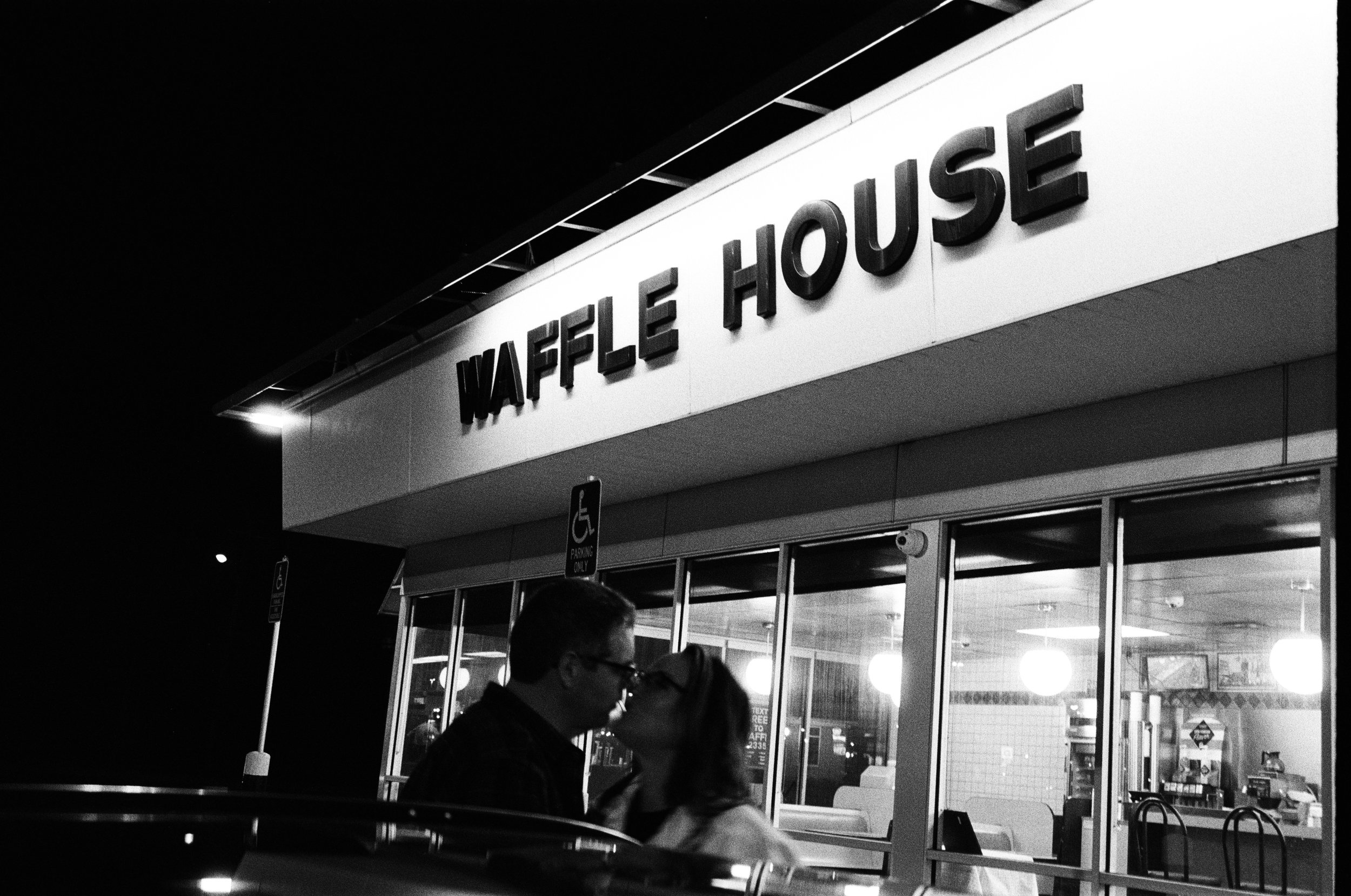
Point proven. March 2022. Photo by Linda Jean Stokley.
Part III: Epilogue
I like to think chocolate—insert an inadvertent typo for a newest addition to the list—chocolate Cravy…
Ahem.
I like to think chocolate gravy is of similar importance to that of Jesus feeding the multitude with the loaves and the fishes. It fills our bellies and hearts with shared experiences that reach far beyond our own breakfast tables.
A couple of years ago, my Mississippi flatlander family experienced the hallelujah of chocolate gravy. They embraced the tradition with their usual passion for Southern delicacies. It was a memorable gift on Christmas Day.
The best beginning I can possibly ask for a holiday breakfast is a big, hearty biscuit (gimme a tall boy), add a little more salted butter, and spoon a generous pour of chocolate gravy on the plate. To complete the experience, my personal preference is to top that with sliced strawberries. A chocolate-covered strawberry on a biscuit. (Did I mention we played Biscuitfest a few years in a row?)
And, yes, even my father-in-law who won’t let gravy touch his lips on a good day, will never, ever turn down a huge plate of biscuits smothered in chocolate gravy.
For all the doubters and naysayers, the recipe is below. Join us in the land of the converted.
Musician and buddy, Sam Gleaves, graciously shared his no-fail biscuit recipe and gave me permission to share it with you. I have heard from two close friends who say these are the best biscuits they’ve ever had. Sam adapted this recipe from noted mountain ballad singer Sheila Kay Adams and banjo player Tyler Hughes who each had their own way of making them. (p.s. Today is also the day you should listen to their music.)
Biscuits
3 cups all-purpose flour
3 teaspoons baking powder
1⁄2 teaspoon salt
1⁄2 cup (1 stick) butter or 1/2 cup Crisco
1 1⁄2 to 2 cups buttermilk
Preheat oven to 450 degrees.
Directions
Combine dry ingredients.
Set out the butter to be room temperature. Butter biscuit pans thoroughly. Cast iron is best.
Slowly add the butter to dry ingredients in small pieces. Break up the large pieces of butter with a fork or pastry blender. Leave some larger lumps of butter.
Stir in enough buttermilk to make a soft dough. Remove dough on a well-floured surface and fold it over 2-3 times. Cut out biscuits.
Bake at 450 degrees for 12 to 15 minutes. If you like the biscuits more browned, I have baked for up to 20 minutes, depending on the oven. When biscuits are nearly done, take out and dab the tops with pats of butter or Crisco. Return to oven and broil on low for luscious brown tops, watching carefully to avoid burning.
Yields 6 or 7 giant biscuits.
Chocolate Gravy
(from my Mother-in-Law, Theresa Looney)
Ingredients
1⁄4 c cocoa powder
1 c granulated sugar
3 T all-purpose flour (heaping if you want thicker)
A couple of shakes of salt
2 c whole milk (can be evaporated milk)
4 T butter, cubed
1 tsp vanilla
Directions
Sift the cocoa, sugar, flour, and salt into a large skillet. Add the milk in slowly, whisking until smooth.
Cook over medium heat, stirring constantly until the gravy thickens to the consistency of thin pudding, around 8 minutes. The gravy will thicken around the edge first, so keep stirring the bottom and sides.
Remove the skillet from the heat and add your butter and vanilla. Stir until melted and smooth. Serve with hot, buttered biscuits.

Poem, No. 1
“It is humanizing and life-giving to acknowledge that there are many callings in any given life. We are called not merely to be professional people, but to be friends, neighbors, colleagues, family, citizens, lovers of the world. Also, in the course of any lifetime, different callings take precedence at different times.”
It’s time to share a few of these snippets. It may be nothing, but I’m sharing this with you, regardless, and we’ll see if it stirs some dust up into something.
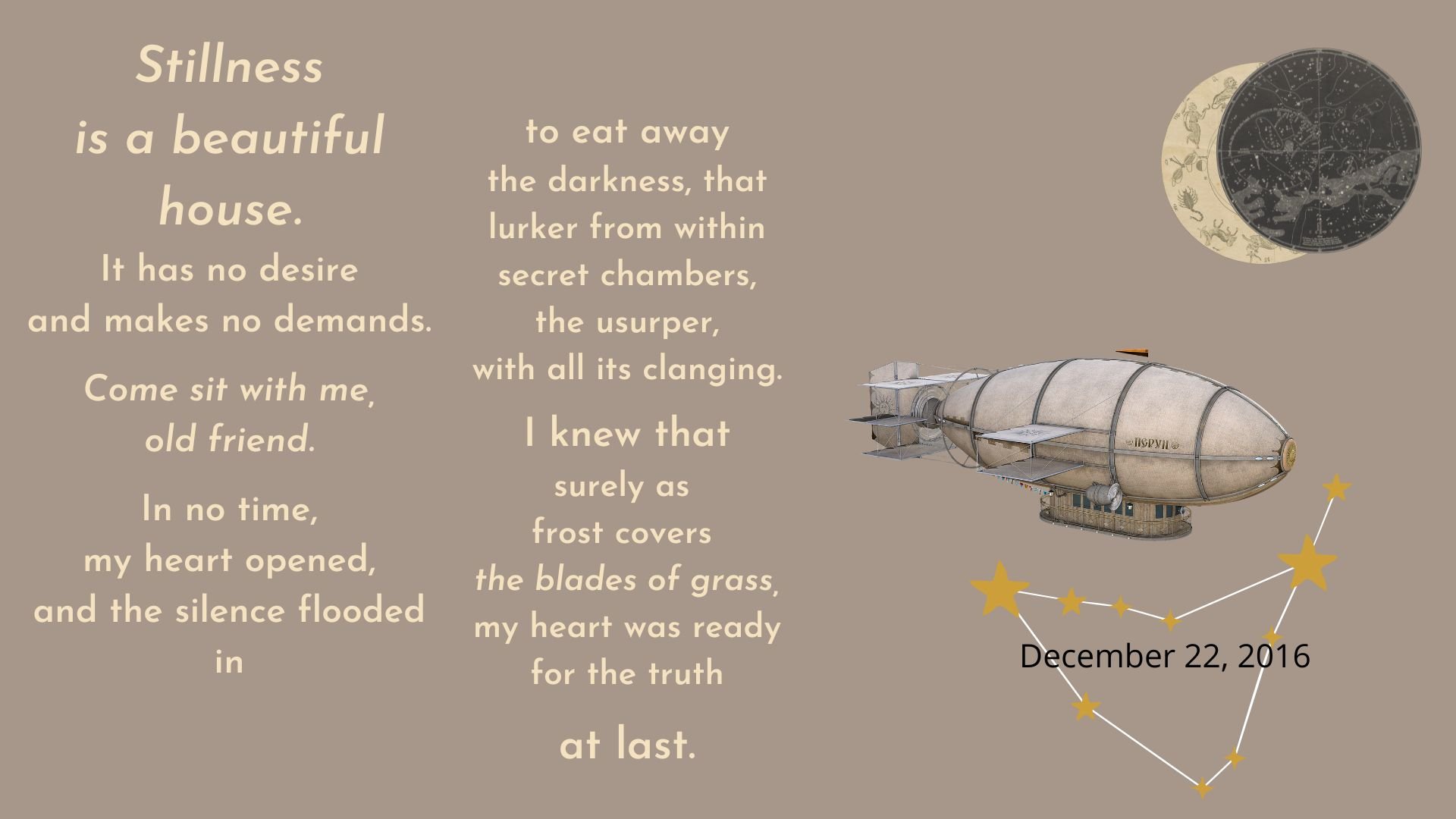
A scribble from the past. —AJK

The Common Persimmon
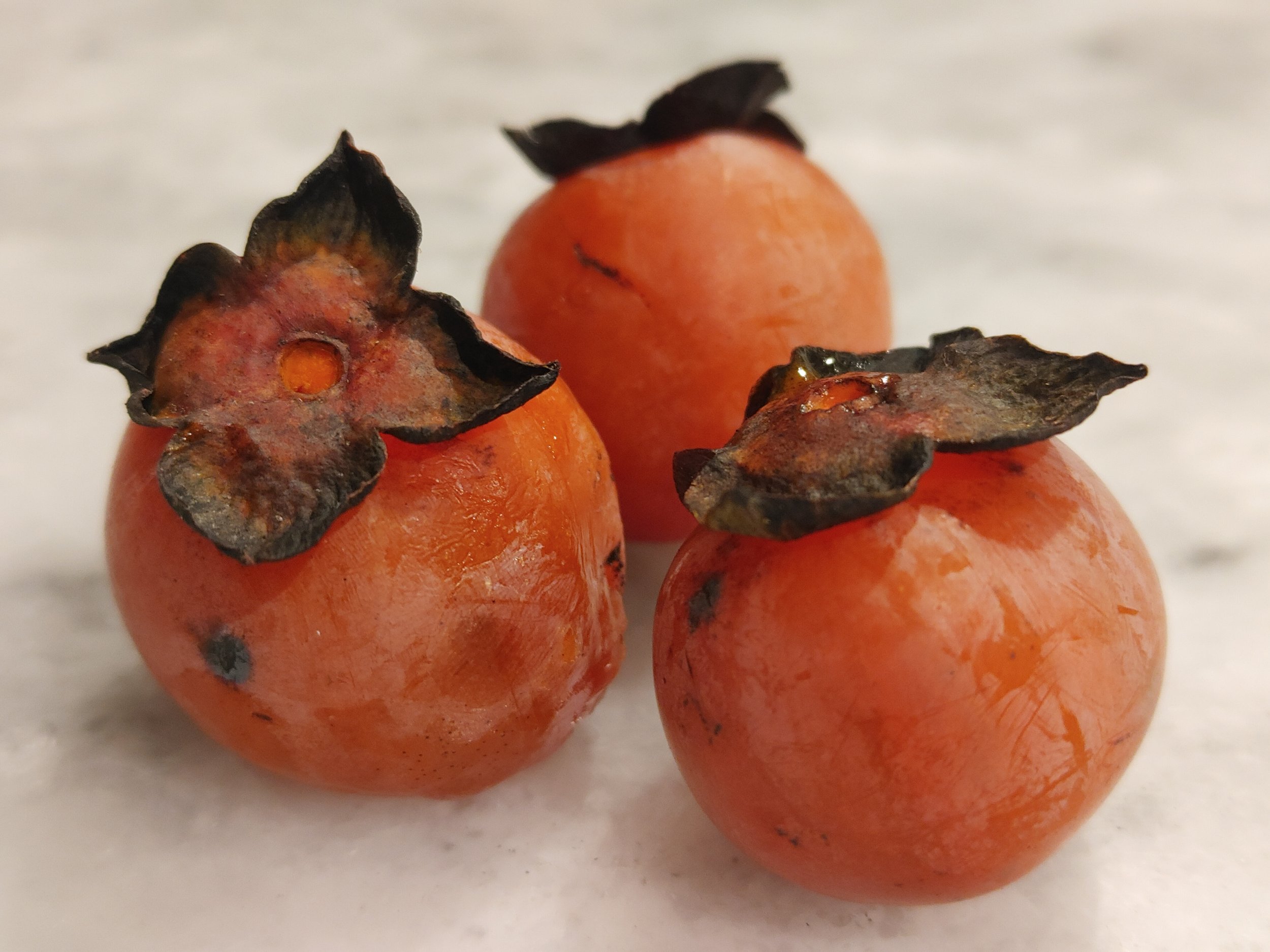
The common persimmon • Central Kentucky • taken with Fuji x100v • 2021.
It’s not really Autumn unless it’s raining persimmons.
I promised myself if I ever posted a recipe on a blog again, I would make sure it was right at the top so visitors can come and go as they please, and get the recipe without scrolling through a bunch of dumb ads, pop-ups, and super-precious storytime tales. You’re welcome.
CONFESSION: I modified this recipe from Full Circle blog. I love the addition of cornmeal! It adds a good flavor and mouthfeel. I borrowed the coffee cake topping from King Arthur, and the orange glaze from this Saveur recipe, which we made last year—I just wasn’t a fan of the lemon glaze and changed it to orange; which, in my opinion, fits the flavor profile much better.
PERSIMMON COFFEE CAKE
SERVING SIZE
Originally, this was a muffin recipe that I adapted into a coffee cake. They are great as muffins, too, but I was trying to get rid of as much persimmon purée as possible since I have so much of it. This is a fun addition to a fall brunch or, as muffins, add them to a Thanksgiving table, or they’re an easy morning grab-and-go stomach filler. It’s full of nostalgic autumn spices and is a perfect sidekick to your cup of coffee.
INSTRUCTIONS
Preheat the oven to 350 degrees F. Grease 12 muffin cups or a 13x9 glass baking dish. In a large mixing bowl combine the flour, cornmeal and salt. In a separate small bowl, whisk together persimmon pulp and baking soda until it begins to thicken. Add the sugar, oil, eggs, spices, and fresh ginger to the persimmon mixture and whisk to combine. Add the wet ingredients to the dry ingredients and use a large spoon or spatula to fold together - don’t over-mix or the bread will be tough and chewy. Spoon the batter into the muffin cups or glass dish,( filling to just 1/4 inch below the rim).
Bake for 15-18 minutes or until a knife inserted in the bread comes out clean.
For coffee cake topping: mix ingredients together and spread over the top of batter until covered.
Meanwhile, make the glaze by whisking together orange juice and zest with the confectioners’ sugar in a bowl until smooth. Let cake or muffins cool for 10-15 minutes and then pour glaze, spreading it evenly over the top with a rubber spatula. Let cool to harden glaze, and then cut and serve.
serves 12-14
INGREDIENTS
1 cup gluten free baking flour (I used all-purpose)
1 cup coarse cornmeal
3/4 teaspoon salt
1 1/2 cups common persimmon pulp, pureed
1 teaspoon baking soda
1/2 cup granulated sugar
1/2 cup vegetable oil
2 large eggs
2 teaspoons ground cinnamon
1/2 teaspoon fresh ground nutmeg
1 tablespoon grated fresh ginger
1/3 cup water
Topping
1 cup (198g) granulated sugar
1/4 teaspoon salt (if you use unsalted butter)
1 cup (120g) King Arthur Unbleached All-Purpose Flour
1 tablespoon cinnamon
6 tablespoons (85g) butter, melted
Optional Glaze
1 cup confectioners’ sugar, sifted
3 tbsp orange juice and added orange zest to taste
After a string of days where the sky poured its heart out, the storm moved on its way—as one of my favorite songwriters, Cahalen Morrison sings, “the rain packed the ground like a humble hen, then the gods packed on up and moved back on out again”—and, the sun came back with a crisp breath of autumn and filled the air with a gold hue. The ground was still damp, the water droplets bent the blades of grass in thankful prayer, and the birds in the treetops rejoiced over their good fortune: a world of culinary bug delights waited on the ground below. And, in the midst, there I sat.
Right before we left for our trip to Colorado, the persimmon tree in our backyard was already beginning to yield some fruit—something I both look forward to—and, if I’m being honest, also kind of dread.
The tree is truly huge: at least 40 feet tall, which is on the higher end of the usual spectrum of persimmon tree height. Her limbs reach out over a corner of the backyard and cover a lot of ground. I know it’s a “she” because there are male and female persimmon trees, and only females can produce fruit. And, by covering a lot of ground, there is an approximate 21 foot by 20-foot area where the fruit drops consistently for at least 2 months.
For the past couple of years, the only thing you can do about it is go out there every day—or sometimes twice to three times a day when it’s absolutely raining persimmons—and pick up as many as possible. Hands and arms full. T-shirts full. Large mixing bowls full.
The storm mentioned earlier THANKFULLY blew out a massive limb and ended up saving me from having to pick quadruple the amount of persimmons I normally have. After a while you lose steam and don’t know what the hell to do with them. They don’t keep as well as the Asian persimmons and it’s imperative you do something with them quick…as we don’t have the freezer space to save them for an eternal amount of time.
My Personal Persimmon History
The only other persimmon tree I’ve ever seen in my life was in Collierville, Tennessee when I was in high school. For about 3 years—from 10th grade to my senior year—I spent practically every Sunday from October to early December fox hunting outside of Memphis (yes, the horses and hounds racing in the open fields kind of foxhunting). We called ourselves the “coyote chasers,” mainly because we “viewed” more coyotes than actual foxes.
On one particular ride, we all stopped for a breather. A friend and I were there on horseback right next to what I thought was a big bush. She reached over and said, “Ooo, look! Persimmons!” and grabbed one and took a bite. My subconscious was familiar with the idea of the fruit but I had never seen nor tasted one. I was immediately curious and reached over and plucked one right off the branch. I remember biting through the soft flesh and tasting its earthy sweetness. My God, it was good.
And, that’s all I remember about it. It’s one of those memories that stuck and stayed. It happened so long ago, I don’t remember what the actual persimmon even looked like.
After that, though, persimmons and I didn’t cross paths again for a very, very long time until I moved to Central Kentucky.
We renovated a very old Victorian house almost 4 years ago now. I noticed a line of trees on the edge of our property that was actively getting choked out by some kind of mutant vine. John took the chainsaw and cut the vines to not only save the trees but also to save us from the prospect of dead, falling trees on our house. The next year, these little apricot-colored fruits began to drop on the ground in our backyard. We inadvertently stepped on them, not knowing the bottoms of our shoes, the dog’s feet, and the ground would be covered in seeds and orange goo. I asked a friend about it, who said, “I think these are persimmons!” as she picked one up and took a bite to confirm.
Well, hello, my little backyard friend.
The Common American persimmon—also known as a “sugar plum”—is about the size of a golf ball. Mine don’t get quite that big, though. Apparently, Asian persimmons have a better shelf life, are a little easier to cook with, and are also quite a bit larger. Common persimmons are inedible until they are ripe, which could lead you to think maybe they’re rotten, because the skin is thin, wrinkly, and the fruit on the inside will squuush out without too much pressure. Handle rather carefully when gathering because if you have a tree as tall as mine, there’s a long way to fall. There are plenty that have been picked on by birds or squirrels, crushed underfoot, or are not ripe—and they get tossed over the fence.
But the ones that make the cut….
Persimmexperimentation
My first persimmon project coincided with my pet pandemic project: making kombucha. Though I’ve since cooled off on the project, persimmon ginger was one of my best flavors. That flavor combo in particular really makes the flavor of the persimmon sing.
A friend recently took some persimmons off my hands to flavor her own kombucha because she liked it so much. I also made a persimmon spiced birthday cake last year for the same friend, which was good but a little dry, i.e. operator error.
I’ve scoured Appalachian cooking and culture Facebook groups to see if anyone else has ideas, but it’s mainly puddings and bread (similar to banana bread). I found a persimmon chia pudding thst sounds good but I haven’t tried it yet.
We tried to make persimmon butter (ȧ la apple butter), but found out the hard way that cooking them completely wrecks the consistency and flavor (it curdled the fruit pulp), and I haven’t quite figured out a version that is good and usable/spreadable in the raw. To be continued on that one; by God, it hasn’t broken me yet and I’ll keep trying (much to John’s dismay).
These days, John is completely OVER persimmons. The mere mention of them sends his eyes rolling into the back of his head with much disdain and gnashing of teeth. Lots of trash talkin’ ensues.
I, however, still love the novelty of having a fruit tree in my backyard, despite the mess, the constant gathering, and the figuring out of what to do with them, it satisfies some primitive, pioneer, early-times-land-dweller within my guts, so I keep messing with them despite the yearly hell I catch from the other half.
Try the recipe. Tell me what you think. If you want any persimmons or seeds, let me know. I HAVE A LOT. another friend told me you could make a good banjo neck from persimmon wood (it’s a type of ebony, so that would be cool).
Now that we’ve covered the topic of persimmons, have you ever had a Paw Paw?? John forbids me to grow a Paw Paw tree in the backyard but we’ll just see about that…
Go down the rabbit hole with me and find out more about the American Persimmon:
Wild Abundance: Facts & Recipes

Blast From the Past: Mountain Workshops in Mt. Sterling

Twelve years together, over 100 collective pounds lost, thousands of miles traveled. This video seems like it was filmed about a lifetime ago.
I love watching it again because there’s so much perspective and magic from the other side. The insight gained from our journey together is enormous. John’s strength from his own recovery helped me get through my own healing journey—and, we remain grateful for every step that took us through the valley and into a better beyond.
Four years ago, Mountain Workshops set up HQ at the Gateway Arts Center in Mt. Sterling. The participants go out into the community to gather stories, videos, and photographs that capture a different perspective of Kentucky than you may think you know. People from all over the United States and the world apply to take part in this experience each year and help to archive Kentucky life.
Enjoy—

A Moment
I found this waiting as a saved draft that I never posted. We always think of our lives now from the view of pre-pandemic and post-pandemic. So, in that spirit:
The world around us has changed so profoundly that I can only hope we all learn its lesson. What lesson you learn is entirely up to you.
From the time during which we were conceived, to the neighborhood in which we grew up, to the state of your life when your eyes blearily pulled apart on January 1, 2020—we are swimming in new waters.
Once spring weather finally came, my quarantine buddy and I could not get enough sun. Her shop downtown closed for a couple of months and my freelance jobs and music performances dried up. We converged each morning in my backyard to let our puppies play and we consistently moved our chairs out of the cold shadows and into the sunshine, desperate, desperate for the warmth. We hunted for morels on her family farm (found a few), let the dogs play in the creek, and ticks be damned, we roamed every inch of the property. We had our morning walk routine, with the cold brew coffee and catch-up afterward and then went on about our day and put together some semblance of “work.”

Last Mule in the Holler
Although my connection with mules is a distant one, I’m barely one generation removed from hard-laboring farm stock. My Daddy and his siblings, my granddaddy, and his granddaddy, and his grandaddy, used mules to farm their land in Panola County Mississippi.
One of the earliest stories I heard about my Daddy was about a time when his father told him to go to the barn, tack up the mule, and get it ready for the day’s work. The mule was much taller than the tow-headed six-year-old and without much effort, could lift his head out of reach and avoid putting the bit in his mouth.
We gravitate toward people who share similar connections. Me and my friends, The Local Honeys, have been on a lot of adventures together. We have shared the stage, roamed the backroads and long highways, explored the deep woods of Kentucky, spilled our guts, and laughed until our sides hurt.
Collaboration proves to us that the giving of ourselves—in our most vulnerable state, the creative process—is one of the most precious offerings we can give to another living soul.
Creating art with your friends is a special gift.
In doing so, we find true meaning and purpose in relationship with another in the here and now—an ever-present reminder that we are not actually alone on this journey. That connection is why we write, why we seek to ask questions of life, why we seek other like-minded people who share that desire and curiosity—and, why we play music together.
I have the honor of saying that I penned a few lines of this beautiful song, Last Mule in the Holler, with my friend, Montana Hobbs. She wrote this song about her family’s mule, Red Rooster. Montana used to show gaited mules when she was growing up and by all accounts—her Daddy, Monte, told me—she was a showy, skilled rider in the ring and, well, we already know she is a badass with a banjo in her hands.
Montana’s way with words and her insight into life is one of the many reasons why I adore her heart.
The Honeys’ recent self-titled album is a gem among gems. I hope you listen to it and carry it with you on your travels down the road.
You’ll find friends there within the beautiful arrangements and poetic lines of verse they’ve written and sung.
Enjoy—
x Anna

TrueSouth TV
Songs start in quiet corners. Ideas are sown into the furrowed lines of notebook paper, they cling to what nutrients live alongside them in the dark soil, and ultimately come to be from the culmination of fingers on strings, and take their shape under the glowing red recording light. And after all that, we release them into the ether, into the sunlight, and let them live their own life far beyond our expectations and the parameters under which they were originally formed, much less intended.
It’s my belief we can only claim a song in its early stages, much like I would imagine it is when you have children. The idea forms in your belly and begins to grow, taking shape, forged with magic and mystery. You edit, you fine-tune, and then at long last, you set it free. The song belongs to the listener now, a different set of ears that has its own experiences and viewpoints. And, the song means what it needs to mean to the listener in a very personal relationship.
We want to say a HUGE thank you to Bluefoot Entertainment, John T. Edge, and TrueSouth TV for using 3 tracks from our self-titled Swift Silver album. The tracks, Come On Home To Yourself, The Fields Have Turned Brown, and Blackbird’s Refrain were all featured on Season 5, episode 5. If you have the SEC Network or Hulu, then you can find it. We are in some great company with other Kentucky artists like S.G. Goodman and our buddies, The Local Honeys.
We’re glad you heard this music and it whispered to you.
In fact, Bluefoot liked Come On Home To Yourself so much, they asked to use it on the Season 5 Promo, too. Check dis out.